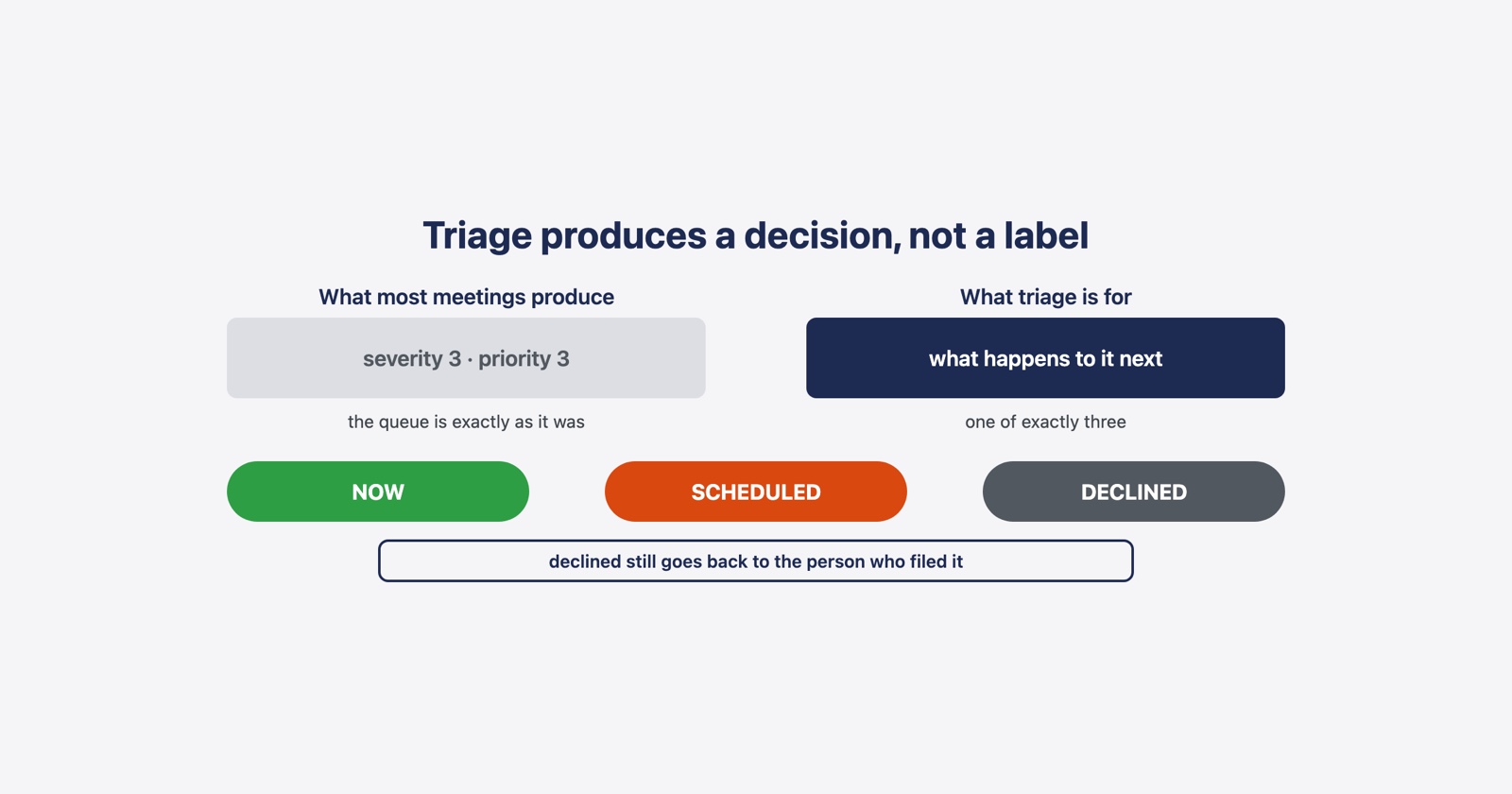
Bug triage is the decision about what happens to a report next. Not what it is worth, not how bad it is, but what happens: somebody picks it up now, somebody commits to a date, or it is declined and the person who filed it is told so.
Most triage meetings do not spend most of their time on that decision. They spend it on reports that cannot be decided yet, and the difference between a thirty minute triage and a ninety minute one is almost never the number of bugs.
Severity is an input, not the output
The common shape is a severity field and a priority field, filled in, and a feeling that triage has happened. It has not. Both are inputs to a decision that still has to be made, and a queue of correctly-labelled tickets nobody has decided about is the same queue it was before the meeting.
The outputs are the three above, and the third is the one teams skip.
- Weak
- Severity 3, priority 3, moved to the backlog.
- Better
- Not doing this. The workaround is acceptable and the fix touches billing. Told the reporter, closed, linked from the billing epic in case that changes.
The first version is not a decision, it is a way of not making one. A backlog that fills with threes is a backlog of things nobody ever said no to, and nothing in the tracker distinguishes “we will get to this” from “we will not” until somebody reads fifty of them two years later.
Where the time actually goes
Watch a triage meeting and count the minutes. A large share of them go to two questions:
“Can anybody reproduce this?” and “what browser was it?”
Neither is triage. Both are information-gathering happening in the most expensive room in the company, weeks after the moment when the information was free. Five people spend four minutes establishing something the reporter knew and was never asked for.
That is the useful thing to notice, because it says where the lever is. The cost of triage is set before the meeting starts, by what the reports contain. You cannot meet your way out of a queue of reports that cannot be decided, and a team that tries ends up triaging the same ticket three weeks running.
Session Replay
Free Chrome extension. One click on the page that is misbehaving captures the screenshot, the console and the network log, and hands you a link to paste into the ticket.
A bug nobody can reproduce is not a low priority bug
It is an undecided one, and the two are filed identically.
Marking it priority 3 reads like a judgement about importance. It is usually a judgement about information: nobody could tell whether it matters. The ticket then sits in a pile sorted by a number that does not mean what the sort implies, and the genuinely minor bugs and the potentially serious unreproducible ones are mixed together and read as one low-value heap.
The honest handling is a separate state. Needs information, with the specific question written down and somebody responsible for asking it, and a date after which it is closed rather than left. Cannot reproduce is a statement about two environments, not about the bug, and it deserves its own lane rather than a low number.
The checklist
Six questions in order, and the order matters: three of them can end the ticket before anybody argues about severity.
# Bug triage: <date>

For each report, in this order. Stop at the first one that ends it.

1. Is it a duplicate?
   Link to the original and close. The duplicate is evidence of frequency, so
   record that it happened again rather than discarding it.

2. Can we tell what happened?
   Steps, what was seen, environment, and something from the browser itself.
   If not: state NEEDS INFO, write the exact question, name who asks, set a
   date it closes if unanswered. Do not assign a priority.

3. Is it ours?
   A third party, an extension or the user's network produces reports that look
   like ours. If it is not ours, say so to the reporter and close.

4. What breaks, and for whom?
   One sentence. Not a severity number yet, the actual consequence: who cannot
   do what.

5. Decide, out loud, one of three:
   NOW      somebody is named and starts
   SCHEDULED  a date or a named release, not "soon"
   DECLINED   with a reason, and the reporter is told

6. Only now, severity and priority.
   They order the NOW and SCHEDULED work. They are not a substitute for step 5.

## Standing rule

Anything in NEEDS INFO for more than <N> days closes with a note. It can be
reopened the moment somebody answers. A ticket nobody can act on is not an
asset.
What this costs when it is skipped
The failure is quiet, which is why it runs for years. Nothing alerts on a backlog that is growing, because growing is what backlogs do. Nothing alerts on a reporter who stopped filing, because an absence raises no event.
So the measurable version is worth writing down once a quarter: how many open reports have never been decided, how many are in a cannot-reproduce state with no question recorded, and how many people who filed something last year filed nothing this year.
The first two numbers are the triage debt. The third is what it cost.
The short version
Triage produces a decision, not a label. Most of the time it takes is spent on reports that could not be decided, which is a problem with what arrives rather than with the meeting. And a report nobody can act on is not a low priority, it is an open question, which is a different thing and belongs in a different pile. The bug report guide covers the arriving half, and severity against priority covers the ordering once the decision exists.