Asana bug tracking that starts from the captured bug

The bug is captured once, and the Asana task is written from that capture into the project you chose: the page it happened on, the browser, the first console error and one link to the recording, the console output and the network trace.

Install ExtensionSee how it works

5,0 aus 17 Bewertungen im Chrome Web Store

Where a bug report goes quiet in a project

Asana holds the work well. The bug arrives in it as a summary, and the summary is the part that ages.

Teams that run on Asana tend to bring bugs in the same way as everything else: somebody adds a task to the project and writes what they remember. Which page it was, which browser, and what the console actually said are the details that get left out, because nobody wrote them down at the time.

The task then waits for a section and an owner. When it finally gets one, the first comment on it is a question, and the answer depends on somebody recalling an afternoon that may be weeks old.

Writing the task from the report settles those questions before they are asked. It opens with the report link, then the page, the browser, who filed it and the first console error, so the owner starts with what was captured.

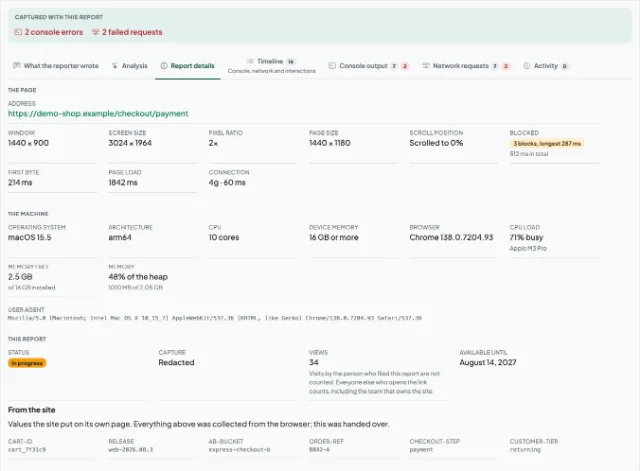
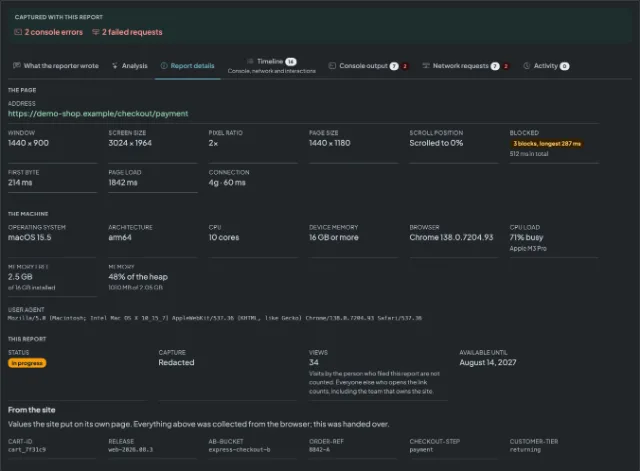
A shared report showing the reporter's note, the console output and the browser it was captured inA shared report showing the reporter's note, the console output and the browser it was captured in

Three steps to a task in your project

Connect Asana and choose the project

A team admin connects Asana, picks the workspace and then the project to create tasks in, and binds it to one of your domains or to all of them. The access the connection asks for is written out on the Asana card on the connectors page.

Capture the bug as it happens

Whoever sees the bug opens the side panel on that page and records it or screenshots it. The browser, the window size, the console output and the network log are kept with the capture, so nobody has to note them separately.

Press the button and the task is in the project

Anybody looking at the report creates the task in one press. It arrives in the project with the report link, the page, the browser and the first console error already in its description.

What lands in Asana

The task description the connector writes, as plain text, the way the project receives it.

What arrives
Creates a task in the Asana project you chose, carrying the report and a link to it. Nothing is filed automatically: a task is created only when somebody presses the button on a report.
What connecting takes
A team admin connects Asana, chooses the workspace and the project to file into, and binds it to one of your domains or to all of them. Read access is used only to list your workspaces and projects, and nothing there is edited, completed or deleted.
In the project
https://session-replay.com/replays/8f3c1ab9d24e

What the reporter wrote

  The discount code applies but the total does not change.

Page: https://shop.example.com/checkout
Browser: Chrome 139 · Operating system: macOS 15.5
Reported by: Anonymous · Severity: Major

12 console lines · 34 requests, 1 failed

First error: Uncaught TypeError: discount is null (cart.js:214)

Asana is one of several destinations a report can be sent to. What each of the others does with a report, and what connecting it takes, is on the connectors page.

What this does not do

The connector passes a report to Asana and stops there. So that you can judge it fairly before connecting it:

  • Nothing is filed automatically. A task exists only when somebody presses the button on a report, never because a report arrived.
  • The capture is never in the payload. The recording, the console output and the network log stay behind the link in the task, and the task carries the details rather than the files.
  • A report's share link is public, and it is the first line of every task. Anyone who can open the task can read the report without signing in.
  • The only thing the connection can write is a task. It reads your user, your workspaces and your projects so you can choose one, and nothing there is edited, completed or deleted.
  • Nothing is read back and nothing syncs. Completing the task does not resolve the report, and comments on the task do not come back.
  • Setup belongs to a team admin, once, for the whole team, and nothing is captured until somebody presses a button.

Questions teams ask before connecting Asana

The report's title becomes the task name, truncated at 250 characters. The description is plain text rather than markdown: the report's link on its first line, then what the reporter wrote, the page, the browser and operating system, who filed it and how severe they called it, how many console lines and requests were recorded, and the first console error on a line of its own. The recording and the full logs stay behind that link.

No. A task exists only when somebody looking at a report presses the button on it. The task's link is kept on the report afterwards, so the next person to open it can see it was already filed, and pressing the button again does not create a second task.

Four scopes: users:read, workspaces:read and projects:read, used to show who connected and to list the workspaces and projects you can choose from, and tasks:write, used to create the task. Nothing in Asana is edited, completed or deleted, and nothing is read back from it afterwards.

No. Asana's access tokens are short-lived, and the connection renews its own when one runs out, without anybody signing in again. Reconnecting is needed only if the access is revoked in Asana or the renewal is refused, and the connectors screen says so when it is.

The first line of every task is the report's link, and that link is public. Anyone who can open the task can read the report without signing in, including anyone the project is shared with.

The one chosen at setup, after the workspace. Every task that connection creates goes there, and the connection is bound to one of your domains or to all of them, so a team running two products can send each one's bugs to its own project.

Give the task owner the evidence, not a summary of it

Capture the page once, pick the project once, and let every bug task arrive with the recording, the console and the browser behind one link.

Install ExtensionSee pricing

5,0 aus 17 Bewertungen im Chrome Web Store