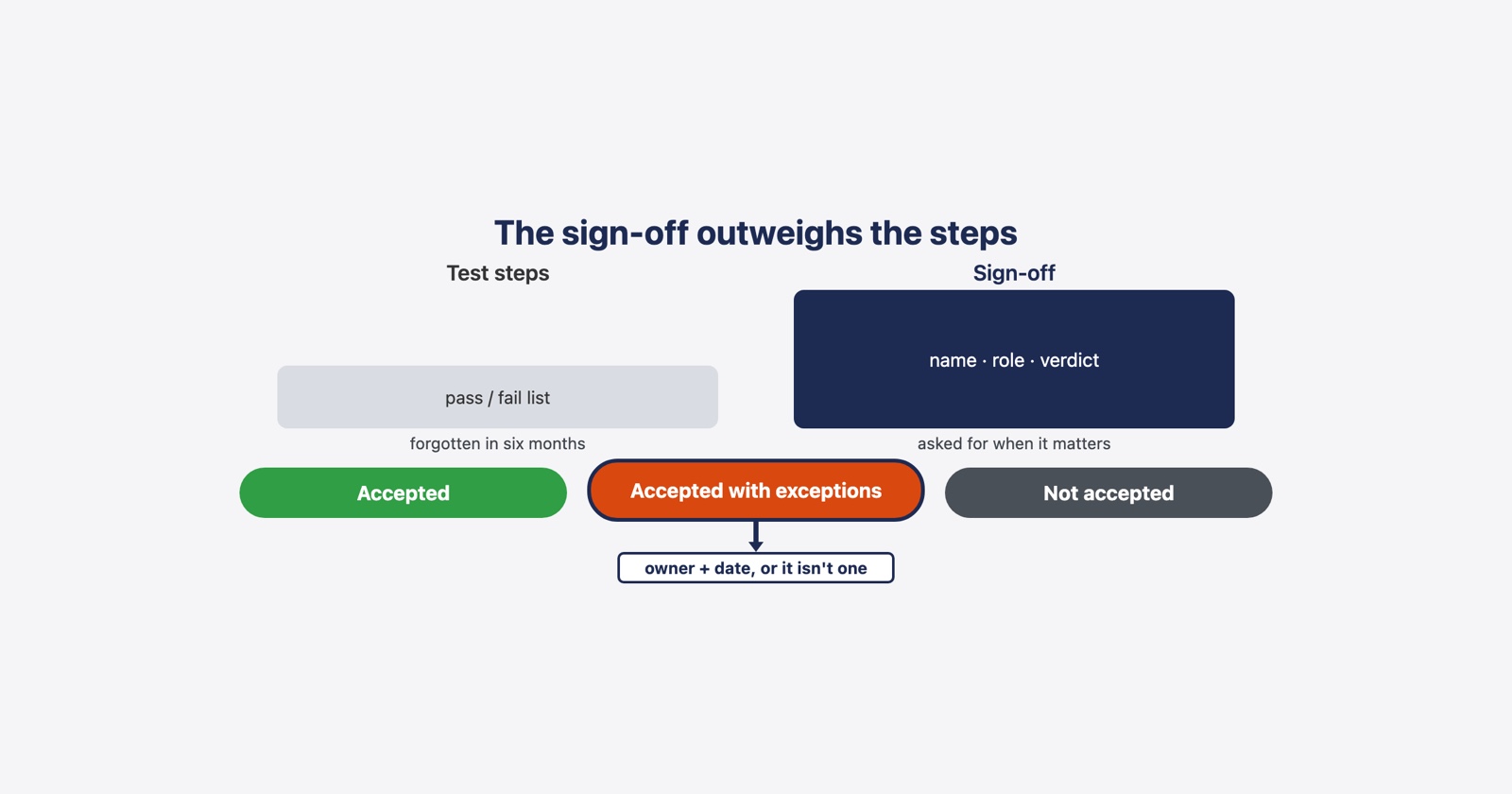
Most UAT templates are a table of test steps with a pass or fail column. That is the part of user acceptance testing that matters least, and it is the only part most templates have.
The test steps are the least durable thing in the document. Six months later nobody reads them. What somebody will ask for, and ask for at the worst possible moment, is who agreed this was ready, and what exactly they thought they were agreeing to. A template whose centre of gravity is the step list cannot answer that. One whose centre is the sign-off can.
Write what people do, not what they click
The second thing most templates get wrong is the shape of the steps. A click path is not an acceptance test:
- Weak
- Click New Invoice. Enter a customer. Enter a line item. Click Save. Check the invoice appears in the list.
- Better
- Invoice a customer for two items and send it to them. Check they receive something you would be happy to have sent.
The first version tests the implementation you have already tested. It passes on software nobody can use, because every individual click works. The second one is the job, and it fails when the software is technically correct and practically useless: the total is right but the currency is wrong, the email arrives with a filename nobody can read, the customer’s name is truncated.
That is what user acceptance testing is for and the only thing it is better at than the tests you already run. A click path hands that advantage back.
The row every template is missing
Almost no UAT ends in a clean yes. It ends in a yes with three things that are wrong and not worth blocking a release for.
A template offering only pass and fail forces a choice between two lies. Fail, and you have blocked a release over a label that is the wrong shade of grey. Pass, and the three known problems have no record anywhere, which means they will be found again by a customer and reported as new.
So the verdict needs a third value, and the exceptions need their own section with an owner and a date beside each one. An exception without an owner is not an exception, it is a decision to forget.
The template
Six sections. Keep Not in scope even when it is one line, for the same reason a test plan keeps it: that is the section that stops somebody assuming the rest was checked.
# UAT sign-off: <release or change>

**What is being accepted:** <one sentence somebody outside the team would recognise>
**Where:** <url, and whether the data is real, copied or invented>
**Open until:** <date testing closes>

## Who accepts it

| Name | Role | What they are accepting | Date | Verdict |
| --- | --- | --- | --- | --- |
|  |  |  |  | accepted / accepted with exceptions / not accepted |

## What to try

One line each, written as something you do in your job rather than as a list of clicks.

1.
2.
3.

## Exceptions accepted

Known to be wrong, and nobody is holding the release for it. An owner and a date, or it
does not belong here.

| What is wrong | Owner | By when |
| --- | --- | --- |

## Not in scope

What was deliberately not checked this time. One line is enough. Zero lines is not.

## If something goes wrong

Say what you were trying to do, what you saw instead, and roughly when. A picture of the
screen is worth more than a description of it. You are not expected to find the cause.
Why the last section is written that way
The people doing UAT are the people who will use the software, which means they are usually not technical. Asking them for a console log or a network trace is asking them to open a panel they have never seen, and the request reads as a test they have failed. The next problem they notice is one they keep to themselves, and the supply of people willing to tell you about a problem is small and entirely voluntary.
So the template asks for the three things anybody can give accurately: what they were doing, what they saw, and roughly when. Those are observations. “It crashed” and “the save is broken” are theories, and a theory arrives looking like an observation and costs you a morning.
Session Replay
Free Chrome extension. One click on the page that is misbehaving captures the screenshot, the console and the network log, and hands you a link to paste into the ticket.
What to delete
Most of it, on a small change. One accepter, two things to try, no exceptions and a one-line scope is a perfectly good UAT record, and it takes four minutes.
What never gets deleted is the sign-off table and the scope line. Everything else in the document describes work; those two describe a decision, and a decision is the thing you will be asked to produce.
If the conditions in the table are vague enough to argue about afterwards, the problem is upstream of UAT and belongs in acceptance criteria. And if you want the same treatment for the document one layer out, there is a test plan template built the same way.